


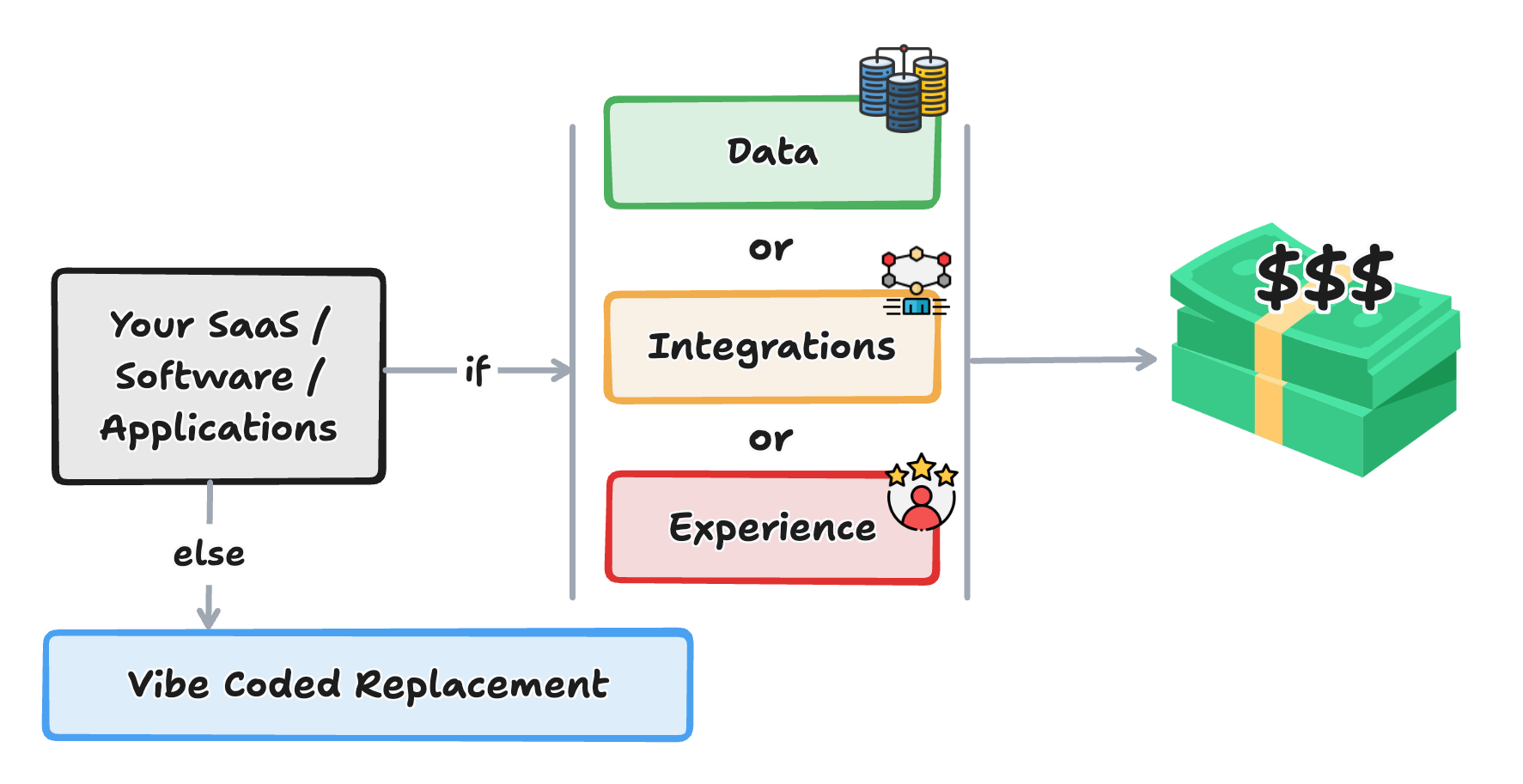
Eventually it's just data, integrations and experience.
TL;DR: Anyone can build software now, so a lot of it is going to die. What keeps the rest alive is data nobody else has, integrations into the tools people already use, and an experience good enough that people would rather use yours than prompt their own.
Somewhere between Claude Cowork dropping its plugins in January and software stocks having their worst quarter since 2008, the SaaSpocalypse went from a Jefferies trader's nickname to a question every company started asking itself, which is basically why are we still paying for this when we could just build it? And a lot of them already have, Retool's build vs buy report found 35% of teams had already replaced at least one SaaS tool with something custom.
So everyone's racing to build their own software, and if you're considering it too, you probably can, so the more useful question is whether it actually survives once it exists. As someone that was hired to replace a finance tool costing a company $50k a month, my take is that the software that doesn't die has D.I.E: data, integrations and experience.
Data
Think platforms like Facebook, Twitter, Netflix or Spotify. A few years ago a clone of one of these was basically the epitome of every CS grad's portfolio, but nobody ever moved over, so what actually keeps them alive? The data that already exists on them.
Why does Airbnb survive despite being a literal marketplace? A decent team could probably rebuild the product in a few months, but they'd be launching with zero listings and zero reviews, and no amount of engineering gets you the trust of booking a place 200 strangers have already vouched for.
The less obvious ones are more interesting:
- Reddit and Stack Overflow both ran on people answering questions for free, but only Reddit kept its community posting, and it now licenses all of that to Google for $60M a year, whilst Stack Overflow's monthly questions have dropped back to 2009 levels.
- Strava clearly gets it too, this June it put public profiles behind a login and started charging developers for API access, because the app is a GPS tracker but the business is years of everyone's runs.
Integrations
However with data and good engineering, we then come to the next part, integrations.
Why doesn't everyone just build their own Linear or Slack? Anyone can vibe code a project tracker for themselves, but the moment it becomes a tool for your whole company, you're suddenly dealing with:
- plugging into Google Workspace or Microsoft 365
- whatever chat or video call tool the team already uses
- SSO, RBAC and permissions, basically the whole enterprise checklist
- audit logs for when someone comes asking who changed what
Linear could really be boiled down to a list of tickets, but teams stay because of how well it plugs into everything else, PRs link themselves from your branch name and move the ticket when they merge, and Linear Asks turns a Slack message into a ticket.
Same goes for customer support. Anyone can build a live chat widget, but Chatwoot is one inbox for email, WhatsApp, Instagram, SMS and voice with SLAs on top, and if you check their pricing, SSO, audit logs and custom roles all sit on the most expensive plan, which tells you exactly where the money is. Even OpenAI and Perplexity are on the customer list of Merge, a company that basically just sells integrations.
This is where the finance tool got hard for me:
- Banking integrations just aren't widely available, and the established platforms got there years ago. Xero once spent a whole year taking its US bank feeds from about 20 to 600+, across over 4,000 institutions that each work a little differently.
- The financial data itself is already owned or paid for by the established players, so I could rebuild every screen the old tool had and still be missing the stuff that made those screens useful.
Experience
And if your software doesn't really depend on data or integrations, that's something anyone could just personalise on their own, which is where experience comes in, and in my opinion experience is the key to future software.
This is all part of the whole taste movement that's taken Silicon Valley by storm (and gotten memed to death along the way), and Paul Graham put it well:
When anyone can make anything, the big differentiator is what you choose to make.
Even as a vibe coder who can build my own stuff, and on paper yes that means endless personalisation, most people don't actually know what they want until someone hands them something good. You can see it in:
- Granola, which raised at a $1.5B valuation even though AI meeting notes are a commodity now, largely by not sending a bot into your call
- Cursor, which started as a fork of the free VS Code and still hit $2B ARR
So doing the research and understanding how people use these tools is critical. I spend a good amount of time in PostHog session replays looking for patterns of behaviour, like rage clicks that get flagged as things to improve, or repetitive movements people make every day that could be turned into automations.
Experience is also not just limited to using a UI, AI plays into it too. I personally love Railway's experience when working with Claude, these days I rarely even open the platform, and Supabase says over 60% of its databases are now launched by AI tools, so a growing chunk of your users might never see your UI at all.
So what's worth building?
The screens on that $50k tool were easy to replicate, but truly it was not so easy at first, as I learnt why tools like it are valuable. Writing code got cheap, but owning data, plugging into your users' world and building something people enjoy using didn't.
So if you're considering building, ask yourself:
- Do I have data nobody else has?
- Do I plug into my users' tools better than anyone else?
- If neither, is the experience good enough that people would rather use mine than prompt their own?
If the answer is none of the three, you're probably looking at a weekend project, which is totally fine, just don't expect anyone to pay $50k a month for it.